Why does hardware sampling still need a converter at all?
Buy a Roland groovebox, an Elektron Tonverk and a Polyend Tracker, and you own three incompatible universes. Every manufacturer packages its multisamples its own way: different key-mapping schemes, different loop metadata, different filter and envelope models baked into a proprietary file nobody else reads. A producer who spent years building a library on one machine gets locked out the moment they switch or add a second box. That fragmentation is the entire reason ConvertWithMoss exists: a free, open-source converter built by a single developer, Jurgen Mossgraber, that reads and writes dozens of these dialects so a sample library isn't hostage to whichever machine imported it first.
What does version 19 actually unlock?
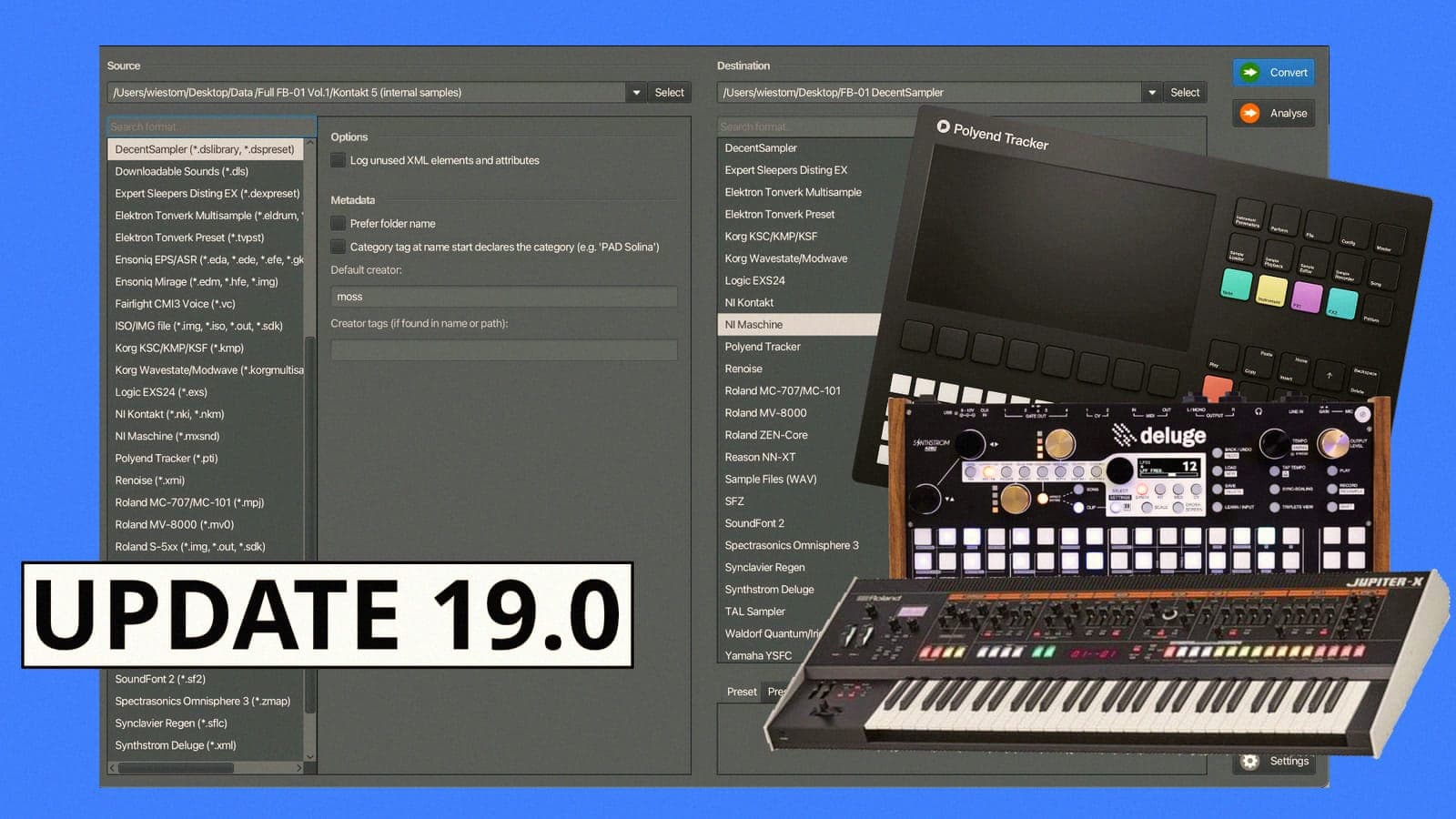
Version 19, released July 18, 2026, adds eleven more formats to that list. Polyend Tracker owners can now pull in libraries built for other gear instead of rebuilding kits from scratch. Renoise users, a real chunk of the tracker-based deep-tech and experimental crowd, get native XRNI support. Elektron's newest flagship, the Tonverk, joins the list alongside Synthstrom's Deluge. Roland gets three separate additions: MV-8000/8800 patches, ZEN-Core sounds and MC-707/101 projects, covering both current production gear and machines still gigging a decade after release. At the far end of the timeline, the tool now reads (read-only) Fairlight CMI III voice files and DLS libraries, so a sample pulled from one of the first digital samplers ever built can land on a 2026 groovebox.
What actually gets fixed in the conversion, not just added?
The two least glamorous additions matter the most day to day.
"Two new processing options: snap loops to zero-crossing and global correction in semitones/octaves." (ConvertWithMoss v19 release notes)
The transpose option corrects a sample's root note by up to 24 semitones, two full octaves, in either direction, without touching where the sample sits across the keyboard, which is exactly the mismatch that turns a straight format conversion into a mangled instrument. Loop points now snap to the nearest zero crossing automatically, killing the clicks that show up when a loop imported from a different format lands mid-waveform. Metadata detection also got smarter: the tool now reads a sample's category straight out of its filename instead of dumping every imported patch into one unsorted pile.
Why it matters
For producers who don't want their workflow dictated by their last hardware purchase, this shrinks the format wall between machines that were never built to talk to each other. It's a small release, but it's exactly the kind of quiet interoperability manufacturers have zero commercial incentive to build themselves.


