What does $15.1 billion actually describe?
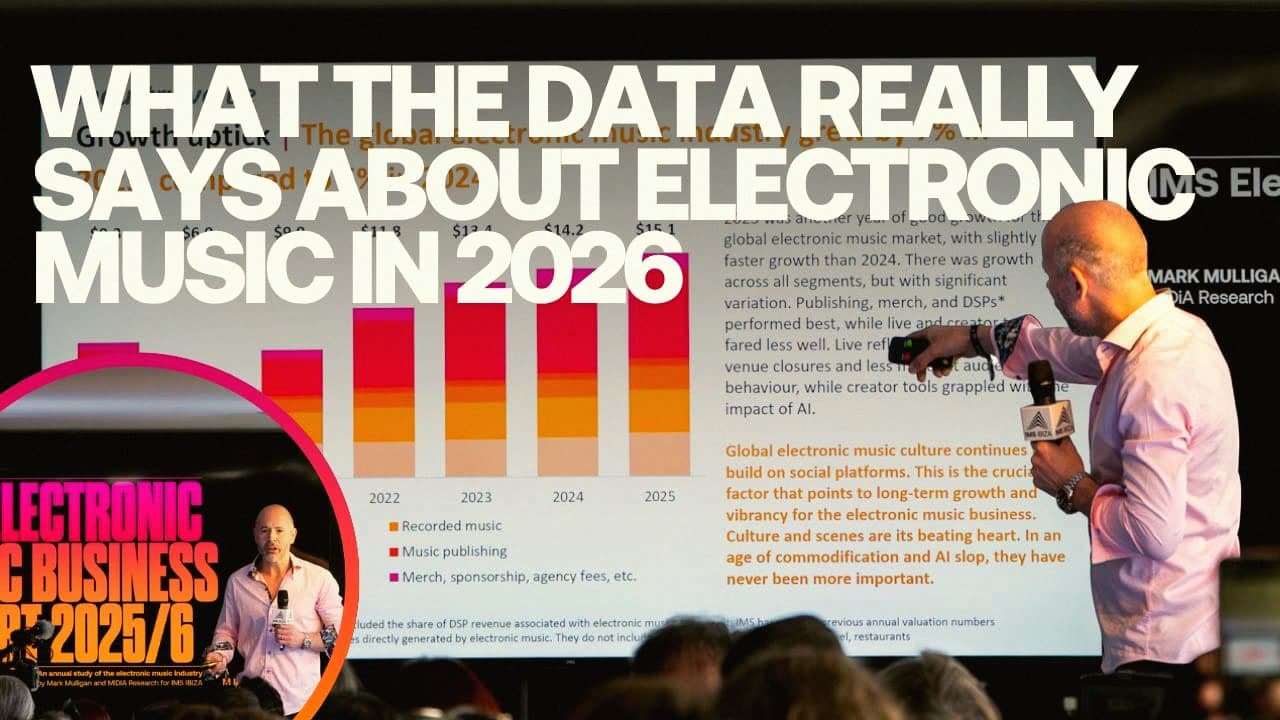
Every spring the dance industry gets a number, and this year it is $15.1 billion, the value the IMS Business Report puts on the global electronic music industry after 7 percent growth in 2025, up from 6 percent the year before. The figure is the whole stack: recorded music, publishing, live, merch, hardware, and for the first time the slice of streaming revenue the platforms keep on electronic music. The more useful part is the argument underneath, where MIDiA Research's Mark Mulligan lays out where the value actually sits for anyone running a small label or a Tuesday-night room.
Mulligan is blunt that streaming is no longer the whole story. "Streaming grew less fast than the overall industry for the first time ever," he says, framing it as good news because the business is finally diversifying into physical, merch and live. For a scene built on rooms and records rather than playlists, that is less a pivot than a homecoming. He sets out four themes: scenes and fandom, the rise of subcultures, the rise of the global south (Indonesia his exhibit A, electronic listeners on Spotify up 77 percent in 2025), and "everyone is a DJ." Germany stays the world's biggest electronic market.
Why is fragmentation good for the underground?
A decade of algorithms on Spotify and Instagram has splintered audiences into niches, and the usual telling is that fewer artists break through. Mulligan flips it: niche scenes can now sustain themselves, which is "good from the underground perspective." The risk he names in the same breath is how fragmented it gets before nobody can build an audience large enough to make a living.
His sharpest reframe is on fandom. The wider industry treats fans as a t-shirt-buying base; he argues that misreads the thing. "Fandom is only a symptom. Identity is the cause." Understand why someone identifies with a scene and you understand what actually holds it together, rather than counting merch units.
"How do you maintain that big reach across any given market across the globe, while also remaining authentic? There is no blueprint for how to do that."
What should promoters and labels take from it?
Two warnings and a trend. The warning for live: in the US fewer tickets sold even as revenue rose, because people are saving up to go out less often. Big-spend, VIP-heavy events look healthy on the books while the crowd thins out, and Mulligan asks how long that holds. The warning on equity: the gender gap among DJs and producers is narrowing, but slowly, stuck around 13 to 15 percent women, which he calls too slow. The trend is sonic. Afro house surged from tenth to second on one sample platform, and harder, faster styles climbed sharply, with schranz uploads up 83 percent year on year. He reads it as the dancefloor mirroring a tense world: "The escapist role of the dance floor has never been more important." That is the report's real message for the underground.