What is UVI Rumble actually doing differently?
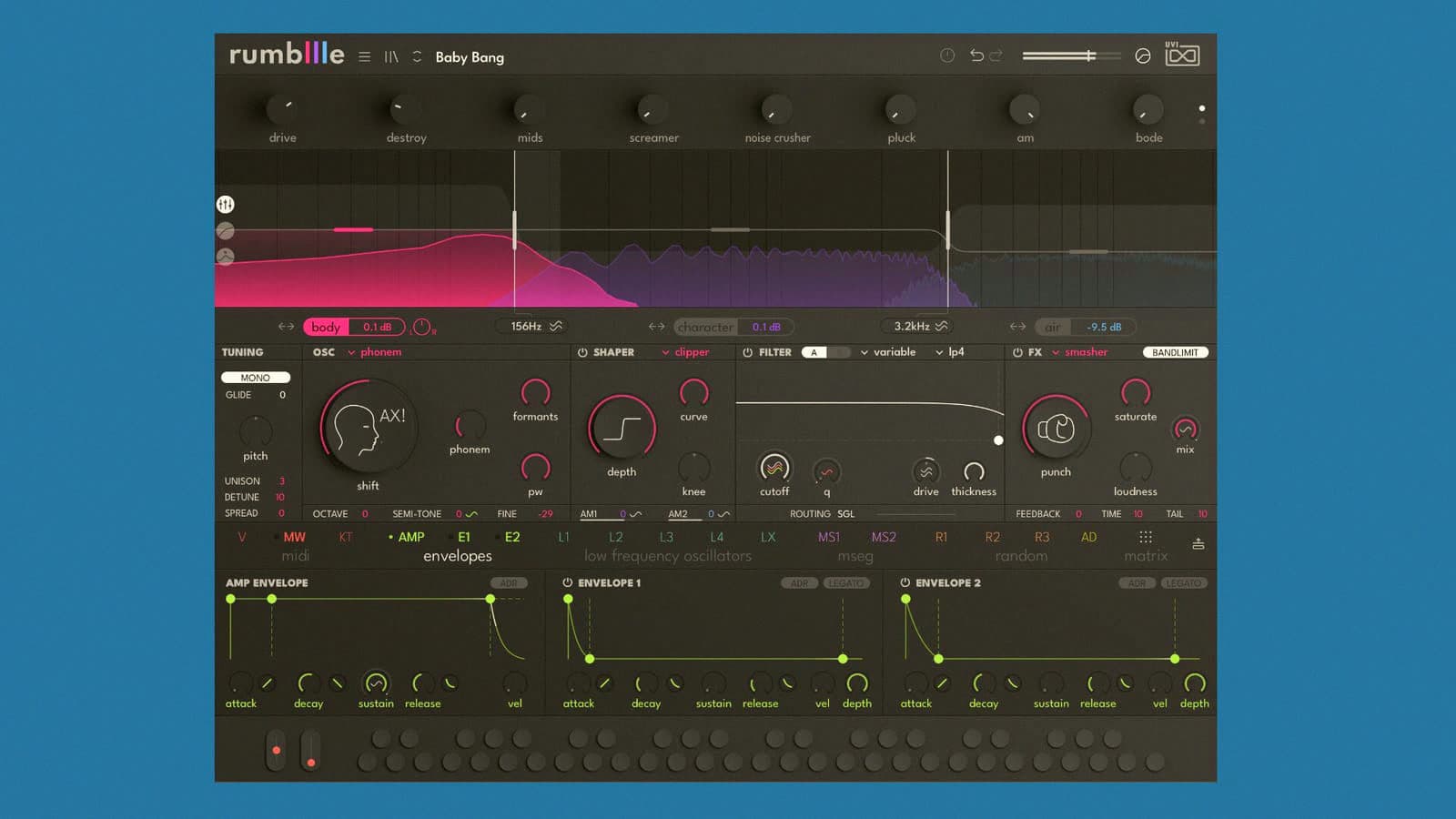
Most bass plugins hand you one signal path and ask you to wrestle the whole frequency range with a single set of controls. UVI Rumble flips that. It splits the sound into three frequency bands, Body for the sub weight, Character for the tonal mids, and Air for the top end, and each band is a full synth engine on its own. You get separate oscillators, wave shaping and effects per band before they meet at shared filtering, compression and EQ.
For anyone who has spent a night layering three different bass patches just to get a sub that stays clean while the mids snarl, this is the obvious move done properly.
How deep does the synthesis go?
Deep. Each band can pull from nine oscillator models (analog, fold, sampler, morpho, timbral, kick, phonem, noise and prisn), run through 10 wave shaper algorithms like hyperfold and hard ring, then hit a dual filter section offering six types per filter including analog, scream and formant.
Three bands, three engines, one bass that holds together from the sub to the top.
Modulation is where it gets serious: 33 sources, four multi-wave LFOs, two 128-point envelopes, three classic envelopes, three random generators, plus 16 macros you can automate straight from the DAW.
What about presets and getting started?
Rumble lands with 500 presets built around the per-band layout, so the architecture is on display from the first patch. There is per-band chorus, delay, reverb and spectral processing, with a master EQ tying it together.