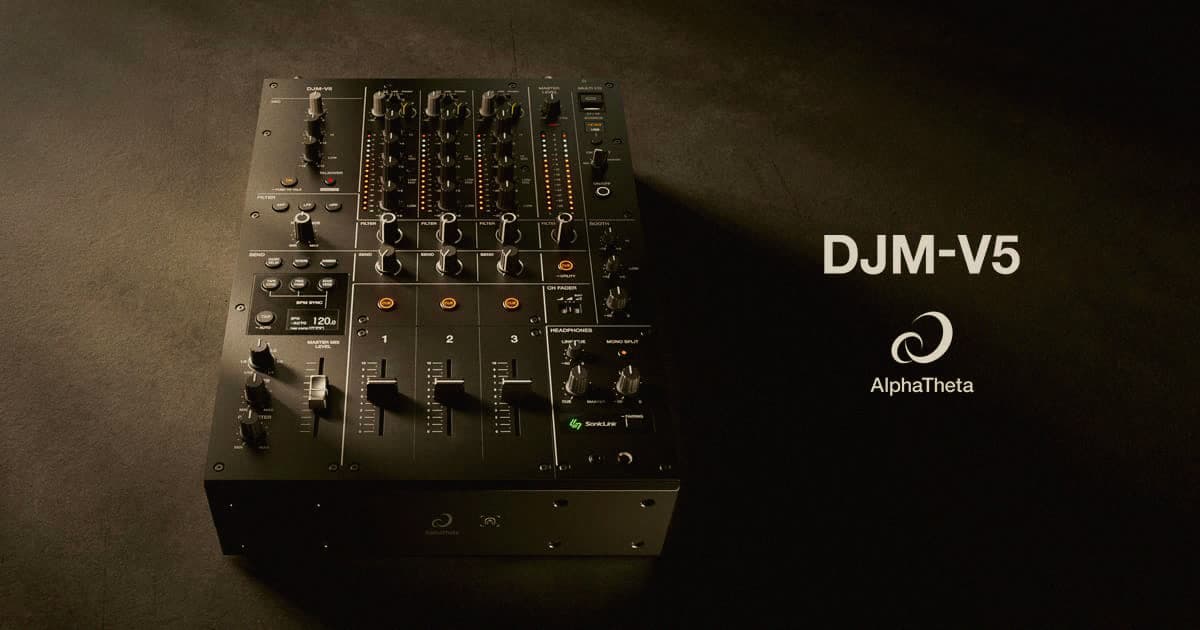
At NAMM in January, AlphaTheta did something its old Pioneer DJ self rarely would: it removed features from a flagship and called it a new product. The DJM-V5 is the DJM-V10 reduced to three channels and a 437.5mm-wide chassis, roughly 30 percent smaller than the V10. It keeps the four-band EQ, the per-channel filter and compressor, the long-throw faders and the Send FX loop. It drops Beat FX entirely. It has no crossfader. List price is 1,999 euros / 1,739 pounds (inc. VAT) / 2,199 USD, and it shipped at announcement.
What did AlphaTheta actually cut, and why?
The two omissions tell you the buyer. Beat FX, the strip of tempo-synced delays and rolls that turntablists and open-format DJs lean on, is gone. So is the crossfader, the single most important control on a scratch mixer. What survives is the four-band EQ and the dual-zone Send FX architecture from the V10, the tools you use to layer two or three tracks into one bed rather than cut between them.
That is a deliberate sorting of the market. The V5 is built for the DJ who treats the mixer as an instrument for blending, not battling: the tech-house and techno player stacking loops, riding sub frequencies, and treating sends like an effects rack. AlphaTheta even added a new "cross-pass" filter, a first on any of its mixers, and a "Soft Mix Curve" that, in AlphaTheta's words, "automatically applies subtle high-frequency attenuation to create smoother, more natural blends" as you pull a fader down. These are mixing tools, not performance gimmicks.
Is the wireless monitoring a real feature or a spec-sheet line?
The headline addition is SonicLink. The DJM-V5 is the first mixer with a built-in SonicLink transmitter, which pairs with AlphaTheta's HDJ-F10 wireless headphones for low-latency cue monitoring with no cable to the booth. For a generation that has watched booth cabling get yanked out mid-set, cutting the headphone lead is not nothing. The internals are flagship-grade too: 96kHz/64-bit DSP, ESS 32-bit converters, a claimed signal-to-noise up to 110dB over USB.
Removing the crossfader from a flagship is a statement: AlphaTheta has decided the house and techno booth and the scratch booth are now two different products.
How does this fit the bigger NAMM 2026 picture?
Look at what AlphaTheta showed next to what its sibling brand did. The same week, Rane (like AlphaTheta, under the inMusic umbrella's orbit of the DJ world) launched the System One, a 2,499-dollar motorised standalone built for exactly the scratch and open-format crowd the V5 ignores, with platters, a crossfader, and Stems baked in. One company, two booths, two opposite philosophies: a stripped studio-grade mixer for layering, and an all-in-one motorised deck for cutting. The middle, the do-everything mixer, is quietly being abandoned.