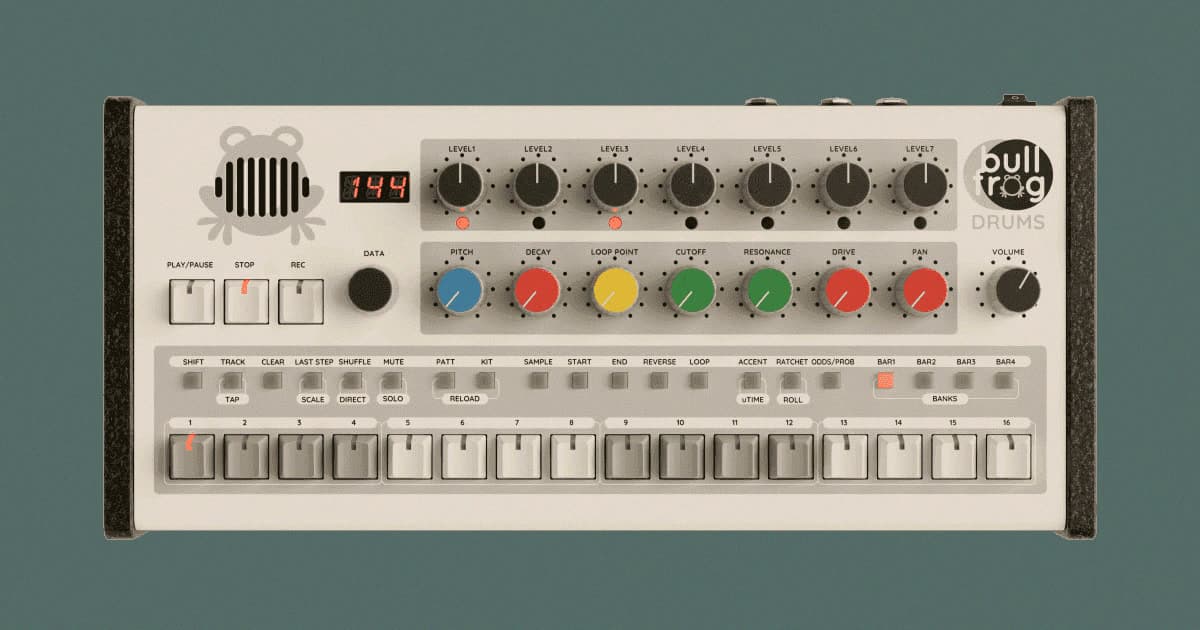
On 4 June 2026, a Brooklyn worker-owned collective called Sonic Liberation Devices opened preorders on something the gear world almost never builds: a drum machine that does not assume the West is the default tuning. The Global South Drum Machine and Sampler costs $1,600, ships in an edition of 250 in early 2027, and is built, in its makers' words, "around sourced sounds and tuning systems from the Global South."
The headline spec is not the voice count. It is the World Globe. Instead of a flat 12-tone keyboard, you navigate a map region by region and pull up "non-traditional tunings sourced with musicians and ethnomusicologists," with chromatic or custom tuning available whenever you want it. The rest is conventional and capable: eight voices per kit, eight kits A to H, a sampler, a step sequencer running 8 to 64 steps that chains patterns into songs. At 41.5 by 23 centimetres it is sized, the collective says, "for the studio, the stage and the backpack."
Why does the tuning matter more than the specs?
Because tuning is where most hardware quietly erases everyone outside the Western canon. Nearly every drum machine and sampler ships locked to twelve-tone equal temperament. Maqam, the microtonal systems of the Andes, the bent intervals that give so much African and diasporic music its feel: all of it gets flattened to the nearest Western semitone the moment it touches a standard grid. An instrument that treats a region's intonation as a first-class citizen, rather than a plugin afterthought, is a small structural correction to a very old default.
That lands directly on the lane this scene argues about constantly. Afro house gets sampled, packaged and sold by producers and platforms far from where it was made, while the tools themselves quietly assume a Western ear. Here is hardware that inverts the order: the sound sources and the tuning come first, sourced in collaboration rather than scraped.
Who is behind it, and why give the schematics away?
The collective grew out of a 2024 NYU graduate thesis by founder Lita Vinueza, who built a first device, the Palestine Drum Liberator, after what she describes as doxxing, harassment and sanctions from the university over her activism. That instrument was shaped with Palestinian composer and producer Omar Ahmad, using recordings of daf, tabla, riq and oud. Sonic Liberation Devices has since become a five-person worker-owned collective.
The open-source promise is the part the industry will find hardest to copy. The schematics, code and research behind the Global South Drum Machine will be published. The collective's manifesto frames it plainly: "technical and historic knowledge should be circulated openly and not be gatekept or privatized," and it shares "schematics, codes, research, and failures because collective access builds collective power." In a market where every major instrument is a sealed box defended by firmware, giving away the blueprint is the actual radical act.
The voices and the tunings come first, sourced with the people who play them, and the blueprint is published for anyone to build on.
Is this a real instrument or a statement?
Both, and the price says so. At $1,600 in a 250-unit run, this is a boutique object, not a TR-1000 competitor, and early-2027 shipping means the verdict on whether it plays well is months away. But the framing is the point. Most gear stories are about more memory, more outs, a cheaper clone. This one is about whose ear the machine is tuned to, and whether the knowledge to build it stays locked or gets shared. For a scene that keeps asking who owns the house Afro built, an open-source instrument that starts from the Global South is a more interesting answer than another sealed groovebox.