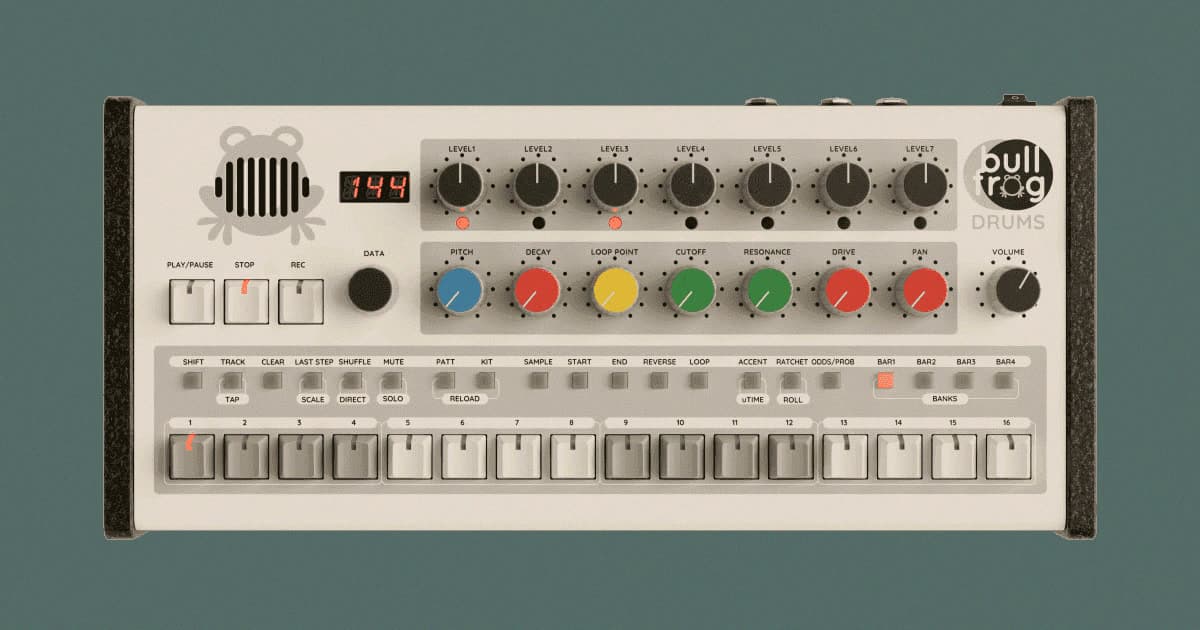
Two years after a prototype sat under glass at Superbooth 2024, Erica Synths and Richie Hawtin have actually put Bullfrog Drums into hands. Units started shipping on 6 May 2026, and the pitch is unusual for a signature box: this is not the techno legend's road rig in miniature, it is a teaching instrument with enough depth that it will not be outgrown in a weekend. It carries on from the earlier Bullfrog Synth, the bright educational mono that made modular ideas legible, and applies the same logic to drums.
What is actually inside the box?
Seven sample-based voices, each with its own per-voice controls: pitch, decay, loop point, cutoff, resonance, drive and pan. That is a sampler, not a fixed analogue voice architecture, which means every track can be a kick, a hat, a clap, a found-sound or a vocal chop. There is 64 MB of sample memory, seven banks of factory material put together by Hawtin and the Erica team, and room for up to sixteen banks of your own. You load samples over USB-C, through the rear audio input, or by recording straight into the unit, so the thing can eat sound from the room it sits in.
The sequencer is where the depth hides. It is a 64-step XoX grid with ratcheting, probability and microtiming, plus parameter locks and automation per track, organised into four banks of sixteen patterns. That is the same vocabulary as the machines minimal producers already build whole sets on, just laid out so a beginner can see cause and effect.
Is this really a learning tool, or a marketing line?
Erica frames Bullfrog Drums as "optimised for a learning path" through drum programming and sampling, and the hardware backs that up rather than hiding it. Color-coded knobs, clicky buttons and a built-in speaker mean you can sketch a groove without a single cable or a monitor chain. The aluminium body measures 40.5 by 18.5 by 6 cm and weighs 2.7 kg, so it sits between a desktop toy and a studio fixture.
The tell is that the connectivity does not stop at beginner. Five-pin MIDI in and out, USB-C for MIDI and firmware and backups, stereo out, line in, a headphones socket, and CV with 1V/oct, gate, reset and clock in and out. That last set is the bridge to a Eurorack case or an external synth, which is exactly the path a curious owner takes six months in.
A drum machine that flatters a beginner on day one and still patches into a modular on day two hundred is a rarer design than the spec sheet suggests.
Where does it sit against the usual suspects?
At 600 euros plus VAT it undercuts the boutique grooveboxes it will get cross-shopped against, and it leans on sampling rather than emulated analogue drum synthesis, which is the more flexible choice for the kind of textural, off-grid minimal Hawtin is associated with. The microtiming and probability are what matter for that sound: they are how you get a pattern to breathe instead of marching. The factory content from a producer with that pedigree is a real selling point, but the longer game is teaching people to record and shape their own.


