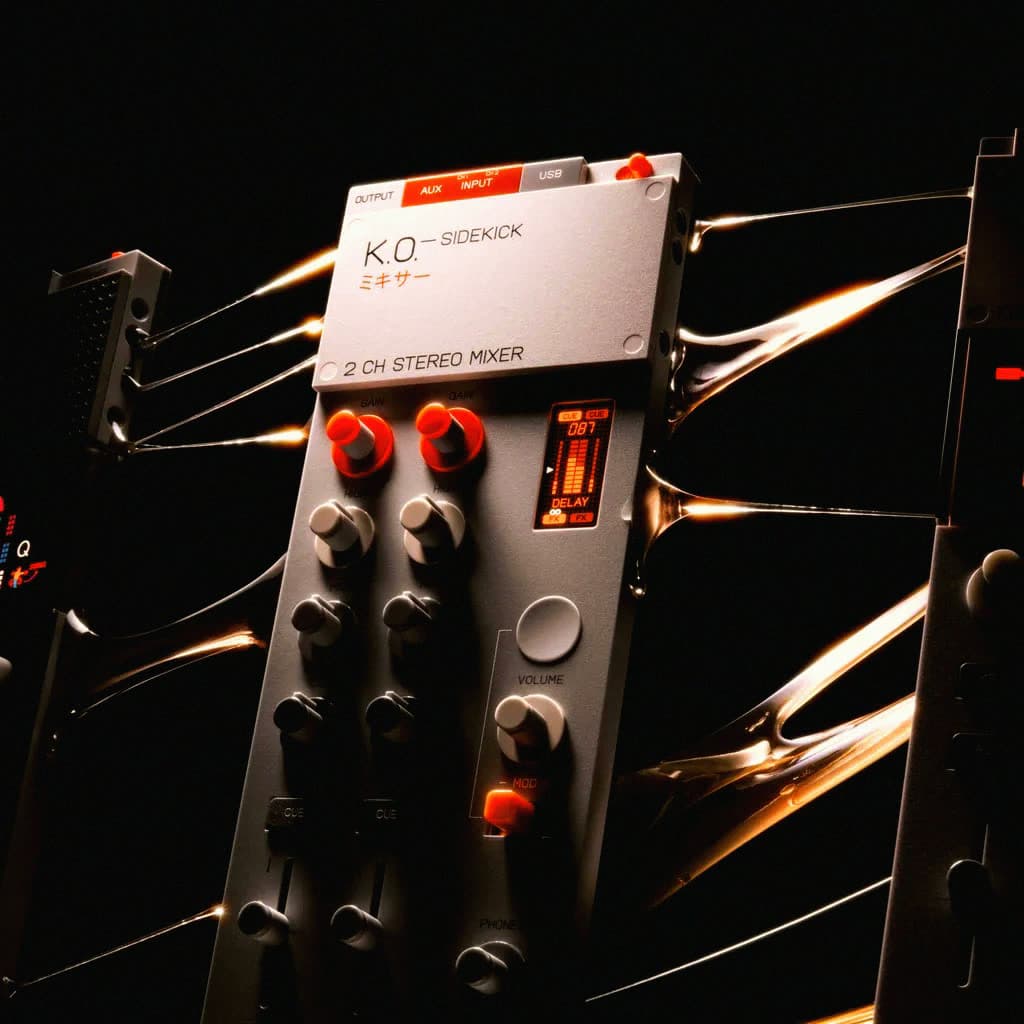
Teenage Engineering has a habit of shipping objects that look like toys and turn out to be useful. The EP-136 K.O. Sidekick is the latest, and at EUR 189 it is the cheapest way the company has yet found to put a real mixer in your bag. Gearnews reviewer Marcus Schmahl scored it 4.5 out of 5 in a piece published on 2 June 2026.
The framing matters here, because this is not a DJ mixer in the turntablist sense. There is no crossfader. What you get is two channels, each with its own fader and cue, which is closer to a portable interface mixer than a battle unit.
What is it, exactly?
Four things in one box. It is a two-channel mixer. It is an 8-in, 4-out USB audio interface. It is an effects unit. And it is a MIDI controller. The box is about the size of a paperback and runs on two AAA batteries or over USB-C.
Each of the two channels carries gain, a three-band EQ with three switchable modes (DJ, studio and parametric), a three-mode compressor, a volume fader and a cue button so you can preview a channel on headphones. There is also a third auxiliary input without its own channel strip.
How do the effects work?
This is where the K.O. Sidekick stops being a plain mixer. Each channel can be pushed into one of six effects: filter, delay, tape, loop, tremolo and siren. You shape them in real time with a pressure-sensitive pad and a bi-directional mod stick on the right side, and crucially you can record those moves as automation loops and let them run.
A two-bar effects automator you can play with your thumb is a more interesting idea than a crossfader at this price.
That is the part that earns its place next to a Teenage Engineering EP-133 or K.O. II, though TE's own line is honest that the plan started as a mixer for the K.O. II and drifted into an effect box with a sequencer.
Where does it fall short?
The review is clear about the trade-offs. The EQ knobs lack grip, and the faders feel fragile, which is the kind of thing that matters if you intend to gig with it weekly rather than use it on a desk. The EQ modes are praised as genuinely useful, the compressors and effects are called playable, and the display is rated well above the price. So the 4.5 is real, but the fader durability is the line to read twice before you commit it to a live rig.