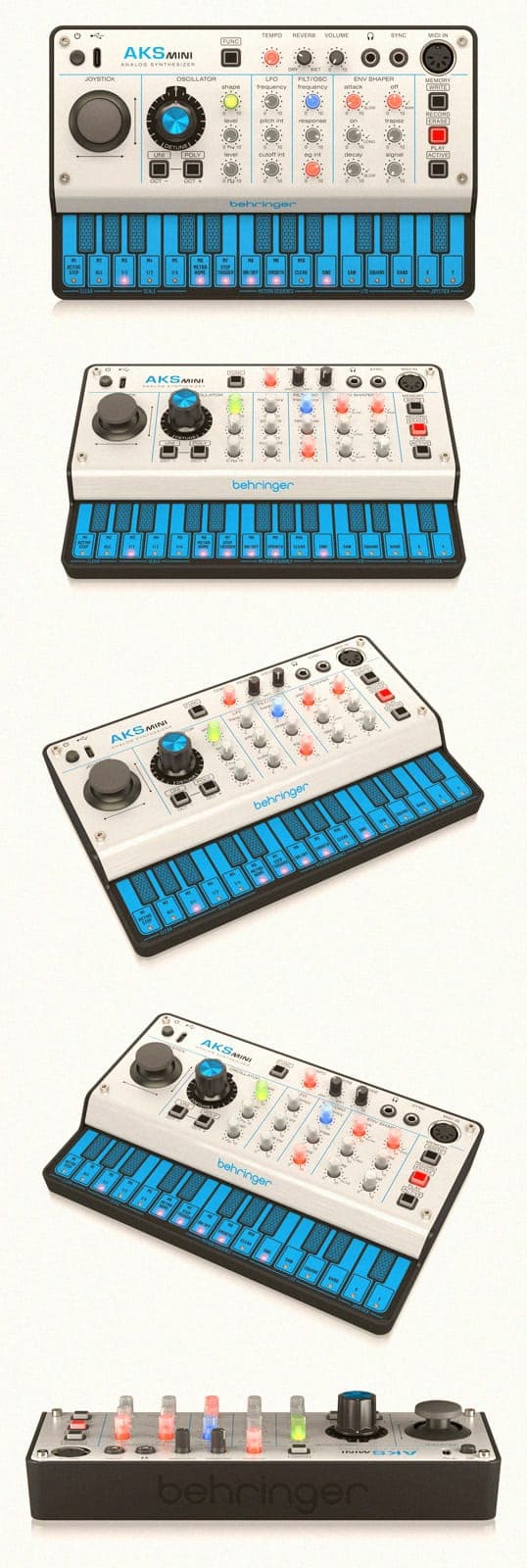
The EMS Synthi AKS was never a mass-market instrument. It shipped in a briefcase, cost a fortune in 1971, and ended up in the hands of people who used it to invent textures nobody had heard before: the wind-tunnel sweep on Brian Eno's early records, the seagull effect on Pink Floyd's "Echoes," the tape-loop chaos across the making of Dark Side of the Moon. It is one of the actual foundational objects of electronic music. Owning an original today means finding one of a few thousand units and paying five figures for the privilege.
Behringer wants to close that gap to £99. The AKS Mini, now open for pre-order after a project that was first teased roughly three years ago, packs 3 multi-wave VCOs into a paraphonic architecture, adds a built-in arpeggiator and a 16-step motion sequencer, and keeps the control layout that made the original strange in the first place: a 27-key touch-sensitive keyboard and a 2-axis joystick that can be mapped to any two parameters, the same non-standard gesture EMS engineers used to steer filter sweeps and pitch by hand rather than a knob.
Is this actually the same circuit?
Coverage of the AKS Mini describes it as a faithful reproduction of the original EMS oscillator and filter circuitry, not a soft-synth approximation wearing a vintage badge. That distinction matters to the people who'll actually buy this: Behringer's whole catalogue, from the Model D to the ARP 2600 clone, has been built on reverse-engineering analog circuits rather than modeling them in software, and that's the reason synth heads take the company semi-seriously even when they resent it.
Why does a 99-pound clone make people angry?
Because it's not really about the AKS Mini. It's about what Behringer's model does to the market underneath it. A company that can clone a landmark instrument and sell it for a fraction of the original's price, at a fraction of the price boutique reissue makers would need to charge, changes what a small manufacturer can justify building. The upside is real: a teenager in Lagos or Lisbon can now put their hands on the actual joystick-and-touchplate interaction that shaped Dark Side of the Moon, no vintage-market gatekeeping required. The downside is also real: it's a lot harder to fund a boutique run of a niche design when Behringer might clone it in three years and sell it for a tenth of the price. Both things are true at once, and that tension is exactly why every Behringer announcement turns into a comment-section fight rather than a shrug.
A company that can clone a landmark instrument for a tenth of the original's price changes what a small manufacturer can justify building next.
What's genuinely new here versus the original?
The original Synthi AKS was monophonic with a basic sequencer built for pattern generation, not performance recording. The Mini adds paraphony, an arpeggiator, and a 16-step motion sequencer that records knob and joystick movement across ten memory slots, features nobody would call vintage-accurate but that make the instrument genuinely more usable in a modern studio. USB-C power and full MIDI implementation, including NRPN and CC control, put it in a workflow the 1971 original was never built for.
Why it matters
A foundational piece of electronic-music history moving from five-figure vintage-market territory to a £99 pre-order changes who gets to actually play with that sound, and it puts more pressure on every boutique maker still trying to sell a faithful clone at boutique prices.
What we think
We'd rather more people get their hands on the actual joystick-and-filter interaction that shaped Eno and Floyd than see it stay locked in vintage-synth collections. But anyone pretending this comes free of cost to the small builders doing the same reverse-engineering work at ten times the price is kidding themselves.


