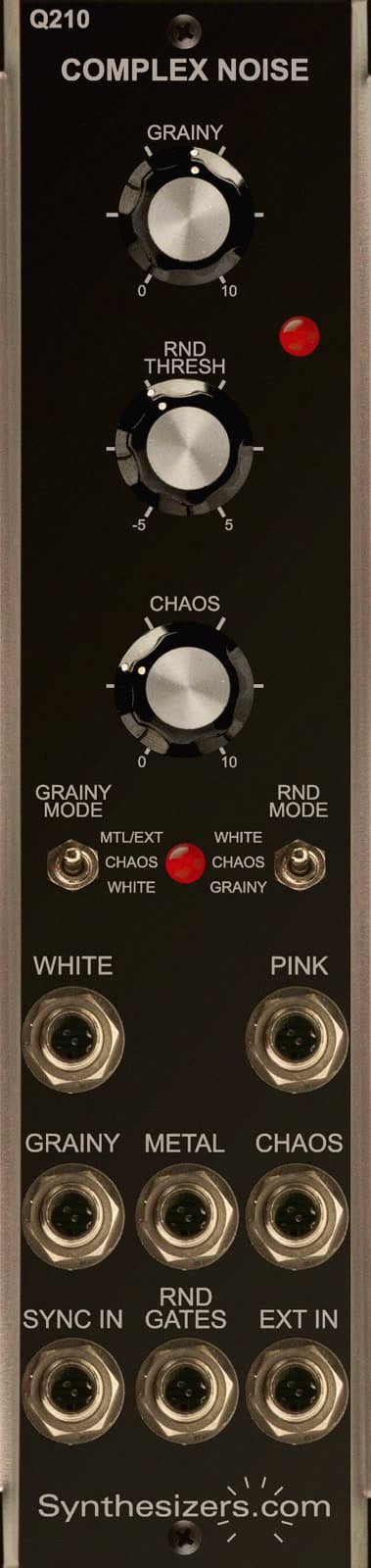
What exactly does the Q210 do?
Synthesizers.com built the Q210 Complex Noise around three separate analog noise engines rather than a single generic circuit. The first is an audio-rate chaotic oscillator based on Chua's circuit, the landmark nonlinear design first published in 1983, generating genuinely unpredictable, non-repeating waveforms rather than filtered white noise. The second is an XOX-style metal signal circuit tuned for hi-hat and cymbal synthesis, the metallic clang classic drum machines used to fake cymbals. The third is a grainy signal circuit that ranges from vinyl-record crackle to campfire pop to the roar of a jet engine, plus random gate outputs with three selectable trigger sources for driving VCAs and percussion elsewhere in a rack.
Everything on the module is analog. There's no digital sample playback and no menu diving: turn a knob, get noise, what the company itself calls a "noisemaker's playground."
Why has it been two years since the last module?
The Q210 is Synthesizers.com's first new module release in two years, according to Synthtopia and MatrixSynth, both of which flagged the gap as notable for a builder that helped define the 5U modular format in the first place. Neither outlet reported a reason for the pause, and the company hasn't issued a public explanation, but the return lands as the biggest news out of the 5U camp in a while, a corner of modular that gets far less attention than the Eurorack market, which came along after it.
Who is this module actually built for?
At $265, the Q210 isn't cheap, but it isn't priced like a boutique one-off either. It's aimed squarely at producers chasing dirtier percussion and texture sources than clean drum-machine hits: breakbeat, industrial techno, and anyone building tracks around aggressive, grainy noise rather than pristine samples. Paired with a filter, VCA and envelope elsewhere in a rack, the company says the module can go from a subtle background texture to the backbone of an entire track.
"A noisemaker's playground."