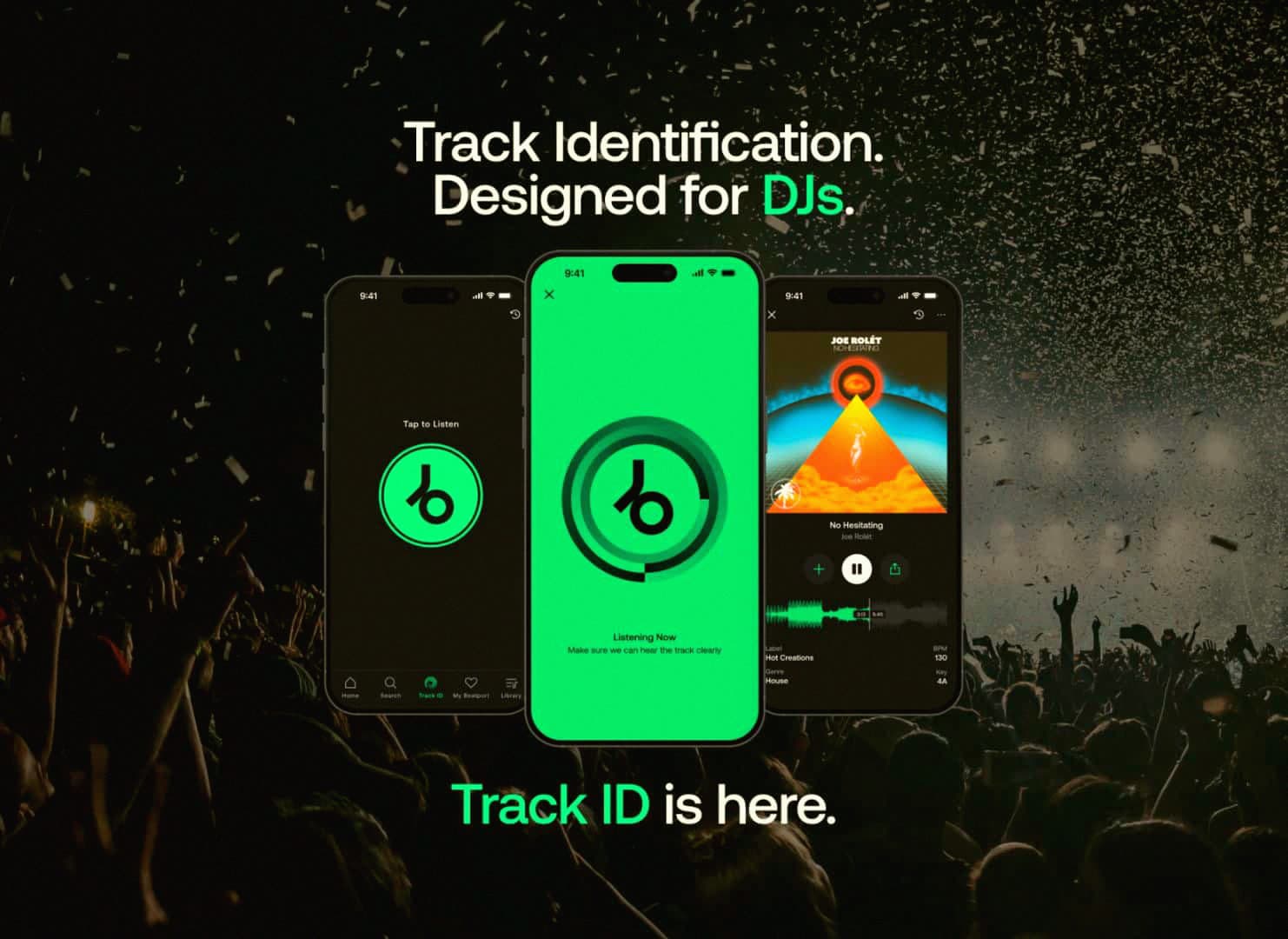
On the surface, Beatport just shipped a Shazam clone. Open the Beatport app, tap the Track ID icon, and it names the record playing in front of you, then drops it into a history you can buy from or save without leaving the app. Launched 12 May 2026, reported the next day by We Rave You, Music Ally and Billboard. Useful, unglamorous, the kind of feature DJs have wanted for years.
Read the executive quotes, though, and a second product is hiding inside the first. Beatport is not really chasing the discovery market that Shazam already owns. It is building a setlist database, and a setlist database is the missing piece in one of the oldest unpaid bills in dance music.
What makes Track ID different from Shazam?
The environment. General recognition tools choke on a club: competing noise, overlapping mixes, two records beatmatched on top of each other, tracks pitched up or down mid-blend. Track ID is engineered for exactly those conditions, built with seeqnc, a Vienna and Berlin company whose stated focus is copyright identification and monetisation at scale. That last phrase is the tell. This is recognition tech aimed at rights, not just at curious dancers.
Why does a recognition app care about royalties?
Because of who is not getting paid. A significant portion of performance royalties from live DJ sets goes uncollected, for a dull but stubborn reason: accurate setlist data rarely exists. Collection societies can only pay out on tracks they can prove were played, and a four-hour set is mostly invisible to them. Chief Revenue Officer Helen Sartory framed Track ID as early infrastructure for setlist reporting. If that ID history feeds into royalty reporting pipelines, it stops being a shopping tool and becomes a mechanism for getting producers paid when their music is played live.
Note the conditional. Beatport has built the sensor, not the payout. "Early infrastructure" and "if it feeds into reporting pipelines" are doing real work in that sentence, and the leap from logging a track to cutting a producer a cheque runs straight through PROs, venues and licensing law.
Recognising the record is the easy part. Turning millions of those IDs into royalties that reach the producer is the part nobody has ever finished.
What does Aslice tell us about the odds?
Everything, because it is the same idea that already failed. DVS1's Aslice asked DJs to voluntarily upload their setlists and share a slice of their fee with the producers they played. It ran on goodwill, and goodwill did not scale. Aslice shut down in 2024.
Beatport's bet is that the thing Aslice lacked was never enthusiasm, it was infrastructure: a catalogue to match against, a user base already inside the app, and the scale to make the data dense enough to matter. Make capture automatic instead of a chore, and you might get the coverage Aslice never reached. That is a genuinely different theory of the problem. It is also unproven, and Beatport has said nothing yet about whether or how any of this money would actually be distributed.